A logo is the easy part
A mark has to survive a favicon, a flyer, a shirt label and five seconds of animation. Brand consistency is worth 23–33% in revenue, and 95% of guidelines go unused.
Most people buy a logo when what they needed was an identity. The difference shows up about three weeks later, the first time somebody asks for a business card.
Here's the thing a logo on its own can't survive: it has to work at 16 pixels as a favicon and at A3 on a flyer. It has to read on a dark screen and on cream card stock. It has to be legible embroidered onto a shirt label the size of a stamp, and it has to still be itself after five seconds of animation. A mark designed for exactly one of those situations will fail the other four, and you won't find out until you're already using it.
The case for doing it once
The commercial argument is better documented than most design arguments. Analyses of brand consistency put the revenue effect at 23–33%, and a Forrester study of 3,100 SMB and mid-market businesses found 68% reported 10–20% year-over-year revenue growth from consistency initiatives.
The mechanism isn't mysterious. Consistency produces familiarity and familiarity produces trust — and 87% of consumers say they'll pay more for a brand they trust.
There's a gap worth noticing in the same research, though: 95% of organisations have brand guidelines, and only 30% use them regularly. Which suggests the problem usually isn't the absence of rules. It's that the rules were written for a PDF nobody opens, rather than derived from the places the brand actually has to live.
If the guidelines and the artwork were made in the same week, by the same people, they tend to agree. If not, they don't.
One mark, five jobs
When we did the identity for Goodfellow Support Services, the mark — a handshake folded into a heart — had to hold up in three unrelated contexts: a phone screen, a doorstep flyer read on a kitchen table, and a five-second animation that draws itself on before the site loads.
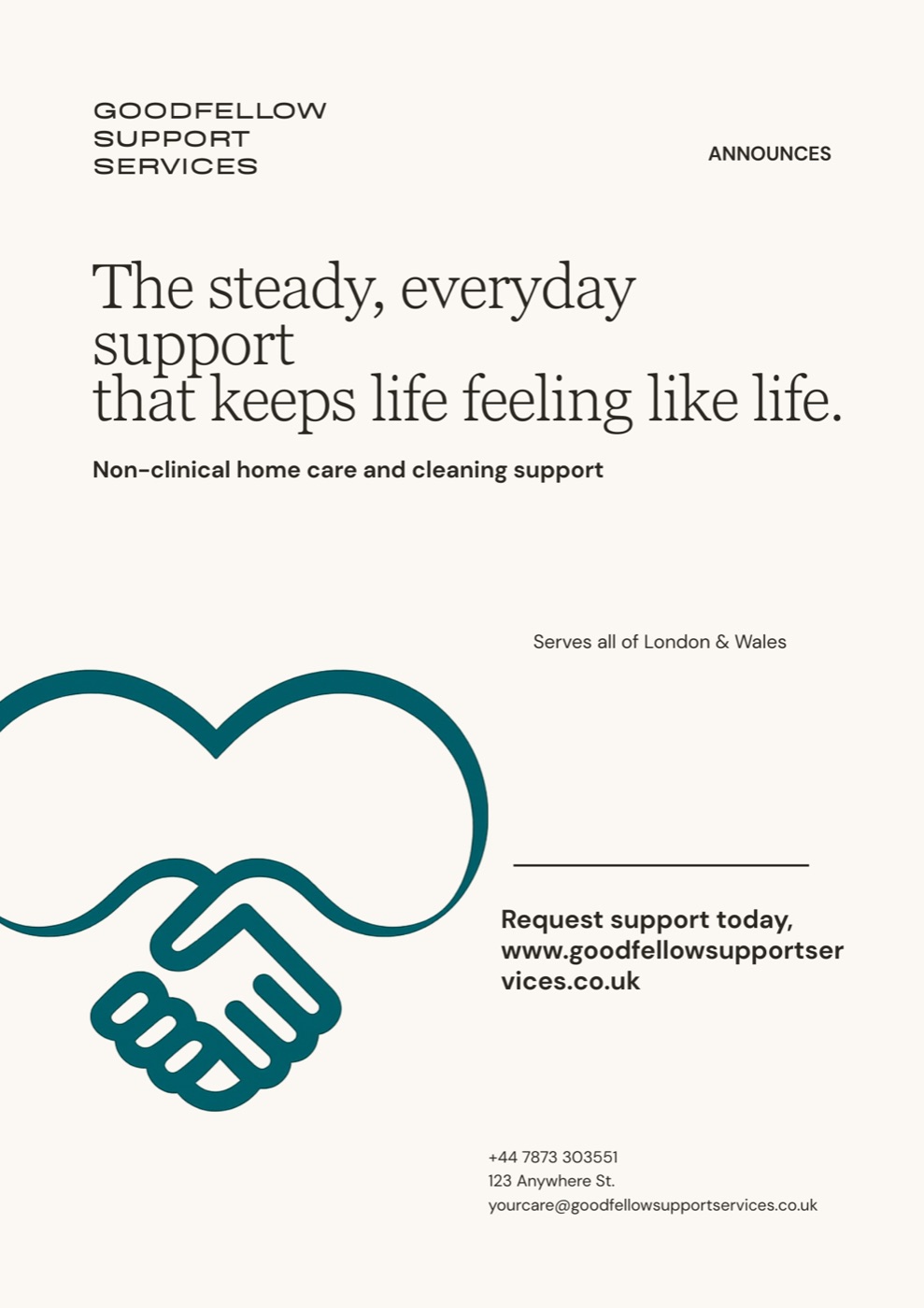
That's why the flyer, the site and the animated logo were designed together rather than ordered separately six months apart. Each constraint fed back into the mark. One line, no gradient, still readable at favicon size — because it had to be.
McCoy's Roofing needed something different again: a monogram that stays aggressive at highway distance on a truck, and calm enough to sit on a business card handed across a kitchen table.
You can see the full set of marks, cards, flyers and tags — including the ones where the answer was deliberately plain.
What to ask for when you commission one
If you're buying brand work, these are the questions that separate a logo from an identity:
- What are the source files? Vector originals, not a folder of PNGs at the sizes somebody guessed you'd need.
- How does it behave on dark? Not "we'll invert it" — an actual designed variant.
- What's the smallest it works at? Then check that claim at that size, not scaled down in a slide.
- What happens when it moves? Even if you don't need animation now, a mark built from clean geometry can move later. One built from a photographic gradient can't.
- Who owns it? Same answer as everything else we make: you do, source files included.
And when not to bother
If you're pre-revenue and testing whether anyone wants the thing at all, a full identity is a distraction dressed up as progress. Get a clean wordmark in a good typeface, spend the money on finding out if the business works, and come back when there's something worth dressing.
We'd rather say that than sell you a brand system for a company that might pivot in October. The work is only worth doing once you know what it's for — which is also, conveniently, when it's cheapest to do well.
Sources: Brand consistency statistics 2026 · Brand consistency as competitive advantage, Marq · 97 branding statistics 2026, DemandSage
Curious what something like this would cost you?
Get an instant estimate